In recent years, China’s innovative drug industry has continued to make significant advances. The scale of overseas licensing deals has expanded, and the country’s clinical development capabilities have gained increasing international recognition. The industry is transitioning from building R&D capabilities toward realizing value in global markets. Although the innovative drug sector has faced periodic pressure from geopolitical developments, market liquidity, and shifts in risk appetite, the fundamental drivers of long-term growth in China’s innovative drug industry remain intact.
Ⅰ. Continued Breakthroughs in Overseas Licensing Accelerate the Globalization of China’s Innovative Drug Industry
China’s innovative drug industry is expanding globally, entering a new phase in which both the number of transactions and their potential deal values are increasing. Since 2025, multiple large business development (BD) deals have been announced, while collaboration models have evolved beyond traditional single-asset licensing to include platform-based partnerships and co-development arrangements.
For example, 3SBio licensed SSGJ-707 to Pfizer in a deal with potential milestone payments totaling US$6.15 billion [1]. Innovent Biologics licensed IBI363 to Takeda in a transaction with potential milestone payments totaling US$11.4 billion. Boan Biotech licensed multiple small interfering RNA (siRNA) drug candidates to Novartis in a deal with potential milestone payments totaling US$5.36 billion. In addition, platform-based collaborations between Jiangsu Hengrui Pharmaceuticals and Bristol Myers Squibb (BMS), CSPC Pharmaceutical Group and AstraZeneca, and Innovent Biologics and Pfizer demonstrate multinational pharmaceutical companies’ growing interest in China’s drug discovery platforms and early-stage pipelines.
Figure 1. Selected Major Business Development (BD) Deals Involving China’s Innovative Drug Industry (January 2025–May 2026)
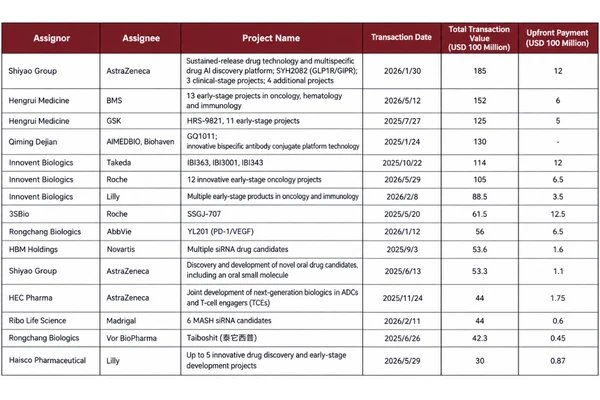
Source: DXY Insight database, PharmaCube, and CICC Research.
From single-asset licensing to platform-based partnerships, the international value of China’s innovative drug industry is expanding beyond individual products to encompass broader R&D capabilities. However, potential milestone payments should not be equated with revenue already realized. The actual value of these transactions will depend on subsequent clinical development, regulatory approval, and commercialization.
Meanwhile, China’s clinical research capabilities continue to advance. According to statistics from the American Society of Clinical Oncology (ASCO) and CICC Research [2], 94 studies from China were selected for oral presentations at the 2026 ASCO Annual Meeting [3], reflecting the growing participation of Chinese research teams in international oncology research. Clinical results from companies including Akeso [4] and Kelun Biotech have attracted attention, further demonstrating progress in areas such as bispecific antibodies and antibody-drug conjugates (ADCs).
Continued advances in clinical data provide important support for the global expansion of China’s innovative drug industry. They may also help Chinese pharmaceutical companies move beyond technology licensing and follow-on innovation toward differentiated innovation and global competition.
Ⅱ. Short-Term Valuation Pressure Persists, but Industry Fundamentals Remain Supportive
Despite the positive development trends in China’s innovative drug industry, sector valuations remain sensitive to the international environment and market liquidity.
On the one hand, intensifying US–China competition in biotechnology and pharmaceuticals, together with related policy and regulatory measures, has increased uncertainty surrounding cross-border investment, R&D collaboration, and international expansion. Market expectations regarding the sustainability of innovative drug BD activity and overseas commercialization prospects have consequently been adjusted. On the other hand, shifts in investor risk appetite and the availability of investment opportunities in other sectors have reduced market tolerance for the lengthy timelines required to develop and commercialize innovative drugs.
According to data from Wind and CICC Research, as of June 25, 2026, the price-to-sales (P/S) ratio of Hong Kong-listed innovative drug companies had fallen to approximately 4.9x from a peak of around 8.5x in early October 2025. The corresponding P/S valuation of the CSI Innovative Drug Index had declined to approximately 5.4x from around 7.0x. These figures reflect a substantial valuation correction. However, a decline in valuations does not necessarily indicate a deterioration in industry fundamentals.
From a policy perspective, improvements in reimbursement access, diversified payment mechanisms, and pricing mechanisms for innovative drugs could help improve domestic market access and payment conditions. At the industry level, some leading companies are entering a phase of commercial value realization, overseas BD collaborations continue to expand, and R&D achievements are increasingly being translated into commercial value.
Assessing the long-term outlook for China’s innovative drug industry therefore requires distinguishing short-term market volatility from underlying industry trends. Share-price movements and valuation changes alone are insufficient to determine the sector’s competitive strength.
Ⅲ. Commercialization Will Be Key to the Future Development of China’s Innovative Drug Industry
Looking ahead, the focus of China’s innovative drug industry is likely to shift gradually from R&D breakthroughs and transaction volumes toward commercial sales growth, the realization of collaboration-related revenue, and global market expansion.
First, domestic commercialization capabilities will be an important driver of corporate value. The sustained growth of innovative drugs depends not only on clinical efficacy but also on reimbursement access, hospital coverage, patients’ ability to pay, and the effectiveness of commercialization and marketing strategies. As more products receive regulatory approval and enter the market, companies’ sales capabilities, cost control, and cash flow quality will increasingly influence their long-term competitiveness.
Second, the sustainability of BD transactions and the realization of their economic value warrant close attention. Overseas licensing can generate upfront payments, R&D milestone payments, and future sales royalties. However, the recognition criteria and sustainability of these revenue streams vary. Compared with relying on a single large transaction, consistently generating high-quality drug candidates and establishing a stable network of global partnerships provide stronger evidence of a company’s long-term innovation capabilities.
Finally, international expansion is moving beyond the signing of licensing agreements toward the realization of tangible commercial value. Progress in overseas clinical development, regulatory submissions, indication expansion, and commercialization will be important indicators of the global competitiveness of China’s innovative drug industry. Companies with differentiated pipelines, sustained R&D capabilities, and mature commercialization systems are better positioned to capture growth opportunities as the industry becomes increasingly differentiated.

Ⅳ. Conclusion: The Long-Term Growth Drivers of China’s Innovative Drug Industry Remain Intact
Overall, China’s innovative drug industry is entering an important phase in which R&D innovation, international partnerships, and commercialization are advancing together. Continued breakthroughs in overseas licensing, greater participation in international clinical research, and gradual improvements in domestic payment mechanisms collectively provide an important foundation for long-term industry growth.
In the short term, geopolitical tensions, changes in market liquidity, and a contraction in risk appetite may continue to cause valuation volatility. Over the medium to long term, however, corporate value will be determined primarily by clinical innovation capabilities, the quality of BD partnerships, commercial revenue generation, and the ability to expand into global markets.
The development of China’s innovative drug industry is not merely about expanding R&D pipelines or increasing the scale of licensing transactions. More importantly, it involves continuously creating innovative assets with global competitiveness and translating them into sustainable commercial value. Short-term corrections may help valuations return to more rational levels, while the long-term growth potential of China’s innovative drug industry remains worth watching as its innovation capabilities increasingly translate into tangible results.
References
[1]https://www.3sbio.com/news/details.aspx?id=319
[2]http://research.cicc.com
[3]https://stock.finance.sina.com.cn/stock/go.php/vReport_Show/kind/lastest/rptid/834393177138
[4]https://static.cninfo.com.cn/finalpage/2026-06-01/1225341005.PDF