
In October 2026, China’s innovative drug approval market remained active. According to a review by 7mg based on the official website of the National Medical Products Administration (NMPA) and publicly available information, a total of three Category 1 innovative drugs were approved for marketing in China between October 1 and October 30, 2026. These drugs cover therapeutic areas including post-infectious cough, generalized myasthenia gravis (gMG), and ischemic stroke risk management.
The products approved this month include Zihua Wenfei Zhisou Granules, submitted by Yuekang Pharmaceutical; batoclimab injection (brand name: Enlida), submitted by Jiaxi Holdings Co., Ltd.; and asundexian tablets (brand name: Sunharbo), submitted by Germany’s Bayer AG.
The innovative directions reflected by these new drug approvals in China in October include the continued advancement of traditional Chinese medicine (TCM) research toward modern clinical evaluation systems; the further expansion of autoimmune disease treatment into targeted intervention in specific immune pathways; and an increasing focus on novel targets within the coagulation cascade in antithrombotic drug development.
I. What Product Structure Do the Three Innovative Drugs Approved in October Present?
In terms of therapeutic areas and mechanisms of action, the three innovative drugs approved in October 2026 exhibit distinct characteristics.
| Drug Name | Approval Date | Applicant | Main Therapeutic Area | Drug Type / Mechanism of Action |
|---|---|---|---|---|
| Zihua Wenfei Zhisou Granules | October 16, 2026 | Guangzhou Yuekang Biopharmaceutical Co., Ltd. | Post-infectious cough (wind-cold lingering in the lung pattern) | Category 1.1 innovative traditional Chinese medicine |
| Batoclimab Injection (Enlida) | October 22, 2026 | Jiaxi Holdings Co., Ltd. | AChR antibody-positive generalized myasthenia gravis in adults | Fully human monoclonal antibody targeting FcRn |
| Asundexian Tablets (Sunharbo) | October 26, 2026 | Bayer AG | Reduction of stroke risk in patients with ischemic stroke or high-risk TIA | Direct FXIa inhibitor |
Unlike approvals concentrated in a single therapeutic area, the innovative drug approvals in October demonstrated parallel development across multiple therapeutic areas.
II. Zihua Wenfei Zhisou Granules: Approval of a Category 1.1 Innovative Traditional Chinese Medicine, Expanding Treatment Options for Post-Infectious Cough
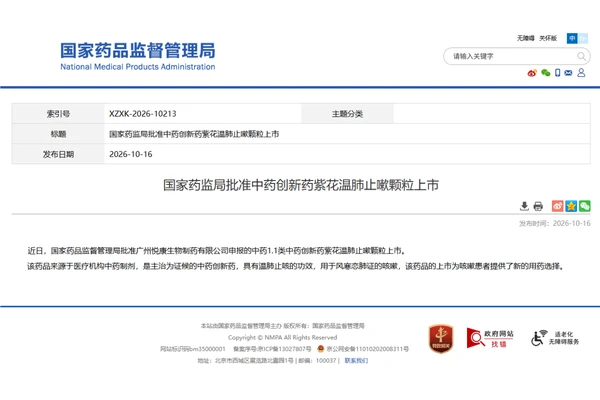
Drug name: Zihua Wenfei Zhisou Granules
Approval date: October 16, 2026
Applicant: Guangzhou Yuekang Biopharmaceutical Co., Ltd.
Indication: Post-infectious cough (wind-cold lingering in the lung pattern)
1. Formula Composition and R&D Characteristics
According to publicly available information, the formula of Zihua Wenfei Zhisou Granules is derived from an empirical prescription with a long history of clinical use. It consists of six traditional Chinese medicinal materials: Aster root, coltsfoot flower, blackberry lily rhizome, dried ginger, mango seed, and schizonepeta herb [1].
The product combines traditional Chinese medicine theory with modern pharmaceutical R&D systems and has undergone clinical development targeting a specific pattern of post-infectious cough.
From an R&D perspective, the product represents an exploration of how empirical traditional Chinese medicine formulas can be translated into standardized production, modern clinical research, and evidence-based evaluation systems.
2. Clinical Research Results
Publicly available clinical research data indicate that, after 14 days of treatment, Zihua Wenfei Zhisou Granules demonstrated significant superiority in the primary efficacy endpoint, the cough relief rate.
The study defined cough relief as a reduction of 50% or more in the cough Visual Analog Scale (VAS) score. In terms of safety, no new safety signals emerged during the clinical trial, and the overall safety profile was favorable [1].
3. Industry Significance of the Approval
Post-infectious cough is a relatively common clinical manifestation following respiratory tract infections. Some patients may continue to experience persistent coughing even after infection-related symptoms have subsided. Developing therapeutic products with clearly defined indications for different TCM patterns and clinical presentations is an important direction in respiratory disease drug development.
The approval of Zihua Wenfei Zhisou Granules further enriches the TCM treatment options for post-infectious cough and provides a new example of the modern development of traditional Chinese medicine empirical formulas.
From the product portfolio represented by the new drug approvals in China in October, Zihua Wenfei Zhisou Granules exemplifies the continued exploration of innovative traditional Chinese medicines for specific diseases and narrowly defined indications, following an R&D pathway distinct from those of the two targeted innovative drugs approved later in the month.
III. Batoclimab Injection: Targeting FcRn to Expand Treatment Options for Generalized Myasthenia Gravis
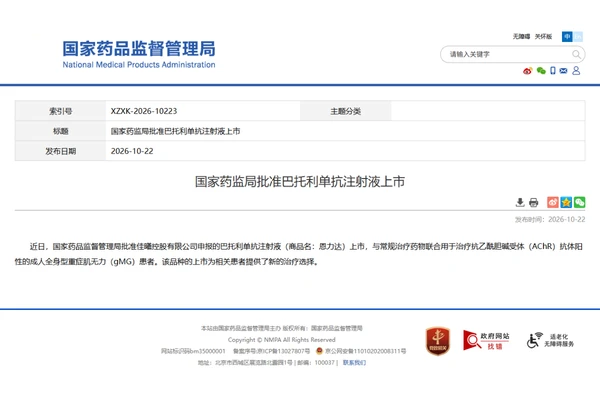
Drug name: Batoclimab Injection (brand name: Enlida)
Approval date: October 22, 2026
Applicant: Jiaxi Holdings Co., Ltd.
Target: Neonatal Fc receptor (FcRn)
Indication: In combination with conventional therapy, for the treatment of adult patients with generalized myasthenia gravis (gMG) who are positive for anti-acetylcholine receptor (AChR) antibodies
1. Treatment Needs in Generalized Myasthenia Gravis
Generalized myasthenia gravis is a chronic autoimmune disorder of the neuromuscular junction, primarily mediated by autoantibodies. Abnormal autoantibodies produced in patients can attack structures associated with the postsynaptic membrane of the neuromuscular junction, impairing the normal transmission of nerve impulses to skeletal muscles [2].
Among these, AChR antibody positivity is one of the most common autoantibody subtypes in gMG. These antibodies can disrupt neuromuscular junction function through mechanisms such as receptor cross-linking, antigen modulation, and complement activation, leading to symptoms including muscle weakness and fatigability.
Current treatments for gMG include acetylcholinesterase inhibitors, glucocorticoids, conventional immunosuppressants, and targeted immunotherapies. Although treatment options continue to expand, some patients still experience inadequate disease control, long-term treatment burden, and relapse.
Therefore, developing novel targeted drugs against pathogenic autoantibodies and their metabolic processes has become an important direction in innovative drug development for myasthenia gravis.
2. Mechanism of Action: Blocking FcRn-Mediated IgG Recycling
FcRn is an important receptor involved in IgG recycling and metabolism. Through a recycling mechanism, it reduces the intracellular degradation of IgG, thereby extending the half-life of IgG in the body.
Batoclimab binds to FcRn and blocks its interaction with IgG, inhibits FcRn-mediated IgG recycling, promotes IgG degradation, and reduces circulating IgG levels [3].
This mechanism can reduce IgG levels, including those of pathogenic autoantibodies, thereby mitigating the pathological effects of autoantibodies on the neuromuscular junction.
Unlike conventional immunosuppressants, which primarily act by broadly modulating immune responses, FcRn inhibitors intervene at a specific stage of IgG metabolism. They represent a targeted drug development strategy for diseases mediated by autoantibodies.
3. Global R&D and Commercialization Progress
Batoclimab was initially developed by South Korea’s HanAll Biopharma and was licensed to Harbour BioMed in 2017 through a strategic collaboration and licensing agreement.
In October 2022, Harbour BioMed entered into a licensing agreement with NBP Pharmaceuticals, a subsidiary of the CSPC Pharmaceutical Group. Under the agreement, commercialization of batoclimab in Greater China (mainland China, Hong Kong, Macao, and Taiwan) would be handled by relevant subsidiaries of CSPC Pharmaceutical Group, while Harbour BioMed would receive tiered royalties based on annual net sales in Greater China.
The approval in China marks an important step forward in the commercialization of batoclimab in the domestic market and further expands the product portfolio of FcRn-targeted therapies in China.
IV. Asundexian Tablets: Approval of an FXIa Inhibitor, Exploring a New Strategy for Ischemic Stroke Prevention
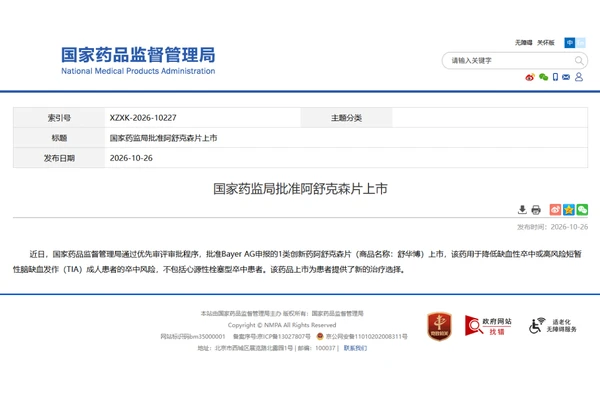
Drug name: Asundexian Tablets (brand name: Sunharbo)
Approval date: October 26, 2026
Applicant: Bayer AG
Target: FXIa
Indication: To reduce the risk of stroke in adults with ischemic stroke or high-risk transient ischemic attack (TIA), excluding patients with cardioembolic stroke
1. Clinical Needs in Secondary Prevention of Ischemic Stroke
Ischemic stroke is a cerebrovascular disease caused by an interruption of blood supply to the brain, resulting in ischemia and hypoxia in brain tissue. For patients who have already experienced an ischemic stroke or high-risk TIA, preventing recurrent cerebrovascular events is an important component of long-term management [4].
Currently, antiplatelet and anticoagulant drugs are important components of antithrombotic therapy, but their mechanisms of action and eligible patient populations differ.
In long-term antithrombotic treatment, reducing the risk of recurrent ischemic stroke while avoiding serious bleeding events remains an important challenge in clinical practice and drug development.
2. Mechanism of Action: Direct Inhibition of Activated Coagulation Factor XI
Asundexian is a direct and selective inhibitor of activated coagulation factor XI (FXIa). FXI is an important component of the intrinsic coagulation pathway and plays a role in the coagulation cascade. Its activated form, FXIa, can further promote thrombin generation and participate in thrombus formation and propagation [5].
Asundexian directly inhibits FXIa activity and intervenes in relevant steps of the coagulation cascade, thereby reducing pathological thrombus formation.
Unlike traditional anticoagulants that act on thrombin or activated coagulation factor X, FXIa inhibitors target a new intervention point in the coagulation pathway. The rationale behind their development is to leverage the differences between the roles of FXIa in pathological thrombosis and physiological hemostasis, with the aim of reducing thrombotic risk while preserving normal hemostatic function as much as possible.
3. Clinical Research Data in the Chinese Population
On October 21, 2026, data from a study in the Chinese population presented at the World Stroke Congress (WSC) further demonstrated the research findings on asundexian in ischemic stroke risk management.
The relevant data showed:
- 32% reduction in the risk of recurrent ischemic stroke: In the Chinese study population, the hazard ratio (HR) for asundexian was 0.68, with a 95% confidence interval (CI) of 0.48–0.96.
- Comparison with global study results: The reduction in the risk of recurrent ischemic stroke in the global study population was 26%. The numerical reduction observed in the Chinese population was greater.
- Safety profile: No increase in the risk of International Society on Thrombosis and Haemostasis (ISTH)-defined major bleeding was observed in the Chinese population.
- Consistency of study results: The direction of the efficacy and safety results in the Chinese population was consistent with that of the global study.
These data provide further research evidence supporting the use of asundexian in Chinese patients with ischemic stroke or high-risk TIA.
From the perspective of innovative drug development, the approval of asundexian not only means that a drug targeting a novel anticoagulant target has entered the Chinese market, but also reflects the evolution of antithrombotic therapy from traditional coagulation targets toward more precise modulation of coagulation pathways.
As a representative innovative product in the cerebrovascular and cardiovascular field among the new drug approvals in China in October, asundexian also provides a noteworthy example of the clinical application and subsequent market development of drugs targeting novel anticoagulant mechanisms.
V. Conclusion
The three Category 1 innovative drugs approved for marketing by the National Medical Products Administration in October 2026 represent different directions in the modernization of traditional Chinese medicine, targeted treatment of autoimmune diseases, and development of novel antithrombotic drugs.
The approval landscape for the new drug approvals in China in October reflects the continued evolution of China’s domestic innovative drug market toward coordinated development across multiple targets, mechanisms, and therapeutic areas.
References
[1] https://youcareyk.com/content/details23_588280.html
[2] Pourmand R. Myasthenia gravis. Dis Mon. 1997 Feb;43(2):65-109. doi: 10.1016/s0011-5029(97)90033-x.
[3] Yan C, Yue Y, Guan Y, et al. Batoclimab vs Placebo for Generalized Myasthenia Gravis: A Randomized Clinical Trial. JAMA Neurol. 2024 Mar 4;81(4):336–45. doi: 10.1001/jamaneurol.2024.0044.
[4] Pacinella G, Bona MM, Todaro F, et al. Tracing Inflammation in Ischemic Stroke: Biomarkers and Clinical Insight. Int J Mol Sci. 2025 Oct 8;26(19):9801. doi: 10.3390/ijms26199801.
[5] Sharma M, Dong Q, Hirano T, et al. Asundexian for Secondary Stroke Prevention. N Engl J Med. 2026 Apr 16;394(15):1467-1479. doi: 10.1056/NEJMoa2513880.