In 2026, the China biopharmaceutical market is entering a critical phase of transformation—from scale expansion to innovation-driven growth, from import substitution to global commercialization, and from isolated breakthroughs to integrated industrial upgrading. The development model that once relied heavily on generic drugs and cost advantages is changing, with innovative drugs, advanced medical devices, AI-driven drug discovery, and cell and gene therapies emerging as important growth drivers.
According to industry data, the Chinese biopharmaceutical market reached RMB 6.55 trillion in 2025, representing year-on-year growth of 11.2%. In the first half of 2026, the value-added output of pharmaceutical manufacturers above designated size increased by 4.6% year over year. Meanwhile, Chinese innovative drugs continued to see strong growth in out-licensing transactions, domestically developed medical devices accelerated import substitution, and the international competitiveness of China’s high-end biopharmaceutical industry continued to strengthen.
Of particular significance, Chinese innovative drugs are shifting from “technology acquisition” to “technology export.” In the first half of 2026, China recorded 68 outbound innovative-drug licensing transactions, compared with 18 inbound licensing transactions. License-out deals are gradually becoming an important mechanism for Chinese pharmaceutical companies to expand globally.
7mg will provide a systematic analysis of the China biopharmaceutical market in 2026 from multiple perspectives, including the PEST environment, market size, industry value chain, competitive landscape, key therapeutic and technology sectors, regional development, capital markets, and risk factors.
1. Five Major Trends Emerging in China Biopharmaceutical Market in 2026
Based on current industry developments, the China biopharmaceutical market is showing five major trends:
- Continued market expansion: The market is expected to reach RMB 7.32 trillion in 2026, maintaining relatively rapid growth.
- Accelerating global expansion of innovative drugs: License-out transactions for Chinese innovative drugs continue to increase, with Chinese pharmaceutical companies shifting from global “buyers” toward global “suppliers.”
- Faster import substitution in medical devices: Breakthroughs continue in advanced imaging, interventional devices, in vitro diagnostics (IVD), surgical robots, and other fields.
- Structural adjustment in the CXO sector: Following a slowdown in global pharmaceutical financing and investment, order growth is under pressure, and the industry is shifting from capacity expansion toward competition based on efficiency and quality.
- AI-driven drug discovery entering the clinical stage: AI is expanding beyond early-stage applications such as target identification and molecular design into clinical development and commercialization.
These developments indicate that the core competitiveness of the China biopharmaceutical market is gradually shifting from cost, production capacity, and generic-drug capabilities toward innovation, R&D efficiency, industrialization, and global commercialization capabilities.
2. PEST Analysis: Four Key Factors Driving Industry Upgrading
2.1 Policy Environment: Further Improvement of Support for Innovative Drugs
Government policy remains an important driver of the China biopharmaceutical market. In recent years, policies supporting innovative drugs have increasingly covered R&D, regulatory review, reimbursement, financing, and commercialization. As strategic emerging industries receive greater attention during China’s 15th Five-Year Plan period, biopharmaceuticals are expected to remain a key strategic industry.
China’s drug review and approval system continues to evolve, helping shorten the time required for innovative drugs to progress from R&D to commercialization. Meanwhile, biopharmaceutical industrial parks across the country are promoting industrial clusters through funding support, talent recruitment, and supporting infrastructure for innovative-drug, advanced-device, and biotechnology companies.
However, cost-containment measures in the healthcare system and pharmaceutical pricing policies are also placing higher demands on pharmaceutical companies. In the future, companies will need to demonstrate not only that their products can reach the market, but also their clinical value, economic value, and differentiated competitive advantages.
2.2 Economic Environment: Industry Growth Becoming More Rational
In the first half of 2026, the value-added output of the pharmaceutical industry increased by 4.6% year over year, indicating continued overall stability. At the same time, investment and financing in the pharmaceutical and biotechnology sector are gradually shifting from rapid expansion toward more rational capital allocation. Investors are increasingly focused on companies with clear clinical value, proprietary technology platforms, and strong commercialization capabilities.
This change indicates a shift in the industry’s competitive logic: “financing-driven R&D” is giving way to “R&D-driven financing.”
For companies lacking differentiated pipelines or experiencing slow clinical progress, securing sustained financing may become increasingly difficult.
2.3 Social Environment: Population Aging Driving Healthcare Demand
Population aging, together with the growing burden of chronic diseases, cancer, and autoimmune disorders, provides a long-term demand base for the biopharmaceutical market.
At the same time, healthcare consumption is gradually shifting from disease treatment toward disease prevention, early screening, and lifelong health management.
Vaccines, early cancer screening, precision medicine, chronic disease management, and innovative biologics therefore have substantial long-term growth potential.
2.4 Technology Environment: AI and Advanced Biotechnologies Accelerating Integration
AI-driven drug discovery, antibody-drug conjugates (ADCs), bispecific antibodies, gene editing, cell therapy, mRNA therapeutics, and small nucleic acid drugs are developing rapidly.
AI is reshaping traditional drug-development models. Processes that previously required substantial time—including target screening, compound design, and candidate optimization—can increasingly be accelerated through artificial intelligence.
However, China still has a degree of reliance on imports for high-end scientific instruments, certain critical raw materials, cell-culture media, and advanced consumables. Strengthening supply-chain autonomy and resilience therefore remains an important priority.
3. Market Size: Expected to Surpass RMB 7 Trillion in 2026
The China biopharmaceutical market reached RMB 6.55 trillion in 2025, up 11.2% year over year, and is expected to expand further to RMB 7.32 trillion in 2026, representing growth of 11.8%.
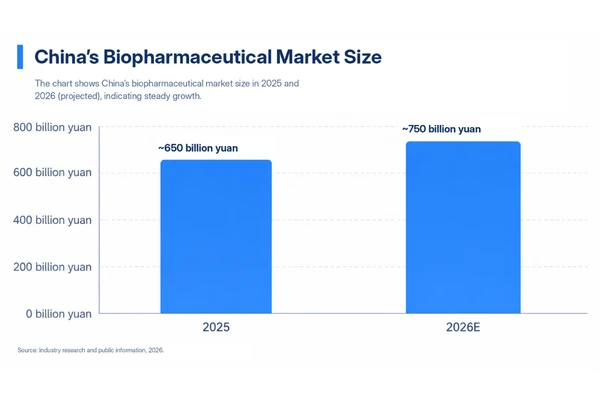
From an industry-structure perspective, chemical pharmaceuticals still account for a substantial share of the market, although their proportion is gradually declining. Biologics, supported by innovative technologies such as monoclonal antibodies, ADCs, bispecific antibodies, and cell therapies, continue to grow at a relatively rapid pace.
| Segment | Market Share |
|---|---|
| Chemical pharmaceuticals | 42.5% |
| Biologics | 28.3% |
| Traditional Chinese medicine | 15.2% |
| Medical devices | 8.5% |
| CXO services | 3.5% |
Based on current industry forecasts, the China biopharmaceutical market could exceed RMB 11.15 trillion by 2030, with biologics potentially accounting for approximately 35% of the total market.
This suggests that future industry growth will increasingly focus not simply on expanding pharmaceutical production capacity, but on innovative drugs, advanced medical devices, and biotechnology products.
4. Industry Value Chain: Comprehensive Upgrading from Raw Materials to End Markets
4.1 Upstream: Strong API Advantages but Further Progress Needed in Advanced Supply Chains
China is a major global producer and exporter of active pharmaceutical ingredients (APIs), giving it significant advantages in the chemical pharmaceutical value chain. However, further localization remains possible in high-end APIs, cell-culture media, chromatography resins, and certain advanced scientific instruments.
As innovative biologics and advanced therapies continue to develop, competition in the upstream value chain will increasingly shift from scale and price toward quality, reliability, and supply-chain security.
4.2 Midstream: Continued Expansion of Innovative-Drug Pipelines
In the first half of 2026, China recorded 1,950 innovative-drug IND submissions and 265 NDA submissions, indicating continued rapid expansion of R&D pipelines.
Oncology remains the largest area of innovative-drug development, accounting for approximately 45% of pipelines. At the same time, R&D activity in autoimmune diseases, metabolic disorders, and rare diseases is also increasing.
Among these areas, ADCs and bispecific antibodies have become important representatives of China’s global innovative-drug strategy. An increasing number of Chinese innovative drugs are entering overseas markets through license-out transactions, as Chinese pharmaceutical companies shift from a model of “R&D and sales in China” toward global R&D and global commercialization.
Meanwhile, the CXO sector is undergoing structural adjustment. Slower global pharmaceutical investment and financing, together with policy changes in overseas markets, have created challenges for some companies, including slower order growth and declining capacity utilization.
4.3 Downstream: Integration of Pharmaceutical Distribution and Digital Healthcare
The concentration of the pharmaceutical distribution sector continues to increase, with large distributors benefiting from strong distribution networks and supply-chain capabilities. At the same time, chain pharmacies, DTP pharmacies, digital healthcare, and online prescription services continue to develop, creating new channels for innovative drugs to reach patients.
For patients requiring long-term treatment, as well as those with oncology and autoimmune diseases, the importance of specialized pharmacies and digital healthcare services is increasing.
5. Advanced Medical Devices: Import Substitution Enters a New Stage
Medical devices are an important component of the China biopharmaceutical market. Industry data indicate that the localization rate of advanced medical devices increased from less than 30% in 2020 to approximately 55% in 2026. Key developments include:
- The localization rate of cardiovascular interventional devices has exceeded 70%.
- The localization rate of IVD products has exceeded 60%.
- The localization rate of advanced imaging equipment has reached approximately 45%.
- Continued technological breakthroughs are being achieved in high-end fields such as surgical robotics.
Historically, advanced imaging systems, interventional consumables, and certain core diagnostic and treatment devices were dominated by international companies. As Chinese manufacturers continue to advance in materials science, algorithms, precision manufacturing, and clinical applications, import substitution is expanding from mid- and low-end products into higher-end segments.
In the future, medical devices + AI could become another growth model, with applications including AI-assisted medical imaging, intelligent surgical systems, and digital healthcare equipment.
6. Competitive Landscape: Chinese Innovative Drugs Entering Global Competition
From a global perspective, the United States continues to lead in original innovation and frontier technologies, Europe has a mature pharmaceutical industrial base, while China is rapidly emerging on the strength of its extensive R&D pipelines, clinical resources, and manufacturing capabilities.
Chinese companies have developed notable international competitiveness, particularly in ADCs, bispecific antibodies, and cell therapies. Within the domestic market, a clear tiered competitive structure is emerging:
Tier 1: Leading pharmaceutical companies with blockbuster products, sustained R&D investment, and global commercialization capabilities.
Tier 2: Innovative biotechnology companies with proprietary technology platforms and high-potential pipelines.
Tier 3: Small and mid-sized companies with limited product differentiation, declining financing capacity, and increasing cash-flow pressure.
As capital allocation becomes more rational, the industry is likely to see more M&A transactions, asset consolidation, and pipeline licensing, further increasing market concentration.
7. Four Emerging Technology Areas to Watch
Over the next several years, technological competition in the China biopharmaceutical market is expected to become increasingly concentrated in several frontier areas.
7.1 AI-Driven Drug Discovery: Moving from Concept to Clinical Development
By 2026, the number of AI-driven drug-discovery companies in China has exceeded 200, with more than 30 AI-developed drug candidates entering clinical development.
AI applications are expanding across the entire process:
Target identification → molecular design → candidate screening → clinical trial design → clinical data analysis
If AI can continue to improve R&D efficiency while reducing development costs, its role could evolve from an auxiliary tool into fundamental infrastructure for drug discovery and development.
7.2 Cell and Gene Therapy: Entering a Period of Technological Iteration
CAR-T therapy has become an important innovative treatment approach for hematologic malignancies. In the future, technologies such as off-the-shelf CAR-T therapies, CAR-T therapies for solid tumors, and CRISPR-based gene editing could expand the application of cell and gene therapies.
However, cell and gene therapies continue to face challenges related to manufacturing costs, long-term safety, quality control, and reimbursement and commercial affordability.
7.3 ADCs and Bispecific Antibodies: Key Areas for Global Expansion
ADCs combine the targeting capabilities of antibodies with cytotoxic payloads to selectively deliver therapeutic agents to cancer cells. Bispecific antibodies simultaneously bind two different targets to enable novel mechanisms of immune modulation.
Both technologies have become important components of Chinese innovative-drug license-out transactions. Going forward, competition among Chinese companies will increasingly shift from pipeline ownership to genuine differentiation in clinical value and global commercial potential.
7.4 mRNA and Nucleic Acid Therapeutics: Expanding Application Boundaries
mRNA technologies are expanding beyond vaccines into areas such as oncology, while small nucleic acid therapeutics are showing significant potential in metabolic and genetic diseases.
As delivery technologies continue to improve, nucleic acid therapeutics could become an important innovative-drug platform alongside small molecules and antibody-based therapies.
8. Key Therapeutic Areas: Intensifying Competition in Oncology, Autoimmune and Metabolic Diseases
Oncology
Oncology remains the largest area of innovative-drug development in China. Competition around conventional PD-1 therapies is entering a more mature stage, while ADCs, bispecific antibodies, cell therapies, and next-generation targeted therapies are becoming key R&D priorities.
Autoimmune Diseases
Autoimmune diseases such as psoriasis and rheumatoid arthritis have large patient populations and often require long-term treatment. Targets such as IL-17 and JAK continue to attract significant R&D interest, while Chinese innovative drugs are expected to further advance import substitution.
Metabolic Diseases
With the increasing burden of obesity and diabetes, GLP-1 and related metabolic therapies have become major growth drivers in the global pharmaceutical market. Chinese companies are accelerating the development of related products and increasingly entering international competition.
9. Global Expansion of Innovative Drugs: The Most Important Structural Change
If Chinese pharmaceutical companies previously relied primarily on importing overseas products to enrich the domestic market, this model is now undergoing a significant transformation.
Since 2022, license-out transactions for Chinese innovative drugs have emerged as a major industry trend. In 2025, the value of license-out transactions reached a high level, while ADCs, bispecific antibodies, and other Chinese innovative drugs attracted increasing attention from international pharmaceutical companies.
The significance of global expansion goes beyond generating licensing revenue. It indicates that Chinese pharmaceutical companies are increasingly participating in global clinical development, regulatory registration, manufacturing, and commercialization.
In the future, companies with genuine international competitiveness will need to combine original innovation capabilities + global clinical-development capabilities + international regulatory capabilities + global commercialization capabilities. This will be an important step in China’s transition from “product globalization” to enterprise-level globalization.
10. Regional Landscape: Three Major Biopharmaceutical Clusters
The China biopharmaceutical market has developed a clear pattern of regional concentration.
Yangtze River Delta
Centered on Shanghai and Suzhou, the region has a high concentration of innovative-drug, advanced medical-device, and R&D service companies, supported by strong scientific resources and industrial infrastructure.
Beijing-Tianjin-Hebei Region
Centered on Beijing and Tianjin, the region brings together research institutions, leading pharmaceutical companies, and innovative enterprises, with strong capabilities in basic research and original innovation.
Guangdong-Hong Kong-Macao Greater Bay Area
Centered on Shenzhen, Guangzhou, and Hong Kong, the region has advantages in medical devices, innovative drugs, and internationalization. Its international platforms can help Chinese companies enter overseas markets.
In the future, regional competition will gradually shift from simply attracting companies and investment toward competition for R&D platforms, talent, clinical resources, and global value-chain resources.
11. Capital Markets: From “Storytelling” to Clinical Data and Commercialization
In the first half of 2026, biopharmaceutical investment and financing totaled approximately RMB 35 billion. Capital allocation has become more cautious, with funding primarily flowing toward technology-intensive areas such as ADCs, cell and gene therapy (CGT), AI-driven drug discovery, and nucleic acid therapeutics.
The change in investor preferences is clear. In the past, investors focused more heavily on concepts and financing speed. Today, they increasingly evaluate clinical data, core pipelines, commercialization capabilities, and cash flow.
As a result, the industry may experience more pronounced survival-of-the-fittest dynamics. Companies with mature products or proprietary technology platforms are more likely to secure funding, while companies lacking meaningful clinical progress may face increasing financing difficulties.
12. Key Risks Facing China’s Biopharmaceutical Industry in 2026
Despite rapid growth, the industry continues to face four major categories of risk.
Technology risk: Innovative-drug development is lengthy and carries a high probability of clinical failure. The long-term safety of frontier technologies such as cell and gene therapies requires continued evaluation.
Market risk: Healthcare cost-containment measures and pharmaceutical pricing policies may continue to place pressure on product margins, while homogeneous competition could further reduce profitability.
Industry risk: Certain CXO segments have excess capacity, and price competition and fluctuations in order volumes may persist.
Internationalization risk: Overseas regulatory policies, data compliance, intellectual property, and geopolitical factors may all affect the global expansion of Chinese pharmaceutical companies.
Therefore, “going global” does not simply mean selling products overseas. Companies need to establish integrated international capabilities covering R&D, regulatory affairs, supply chains, and commercial operations.
13. Outlook: From “Made in China” to “Innovated in China”
Considering market size, policy conditions, technological development, and capital trends, the China biopharmaceutical market has entered a new stage of development. Over the next five years, four major areas are likely to become key growth drivers.
First, biologics will continue to increase their market share. Innovative products such as monoclonal antibodies, ADCs, bispecific antibodies, and cell therapies will continue to reshape the pharmaceutical product mix.
Second, AI-driven drug discovery will enter large-scale adoption. AI is expected to further reduce drug-development costs and improve R&D efficiency.
Third, advanced medical devices will accelerate import substitution. From imaging and interventional devices to surgical robots, Chinese products are expected to expand further into high-end market segments.
Fourth, the globalization of Chinese innovative drugs will accelerate further. License-out transactions will remain an important mechanism for Chinese pharmaceutical companies to access international markets, while some globally competitive products could develop into international blockbuster therapies.
Conclusion
In 2026, the China biopharmaceutical market is shifting from its previous model of scale expansion and generic-drug-led growth toward original innovation, import substitution, and global commercialization.
A market size exceeding RMB 7 trillion represents only one milestone in the industry’s development. More importantly, the underlying industry structure is changing: innovative drugs are increasingly entering overseas markets, advanced medical devices are accelerating import substitution, AI is becoming integrated into drug discovery, and cell and gene therapies as well as nucleic acid therapeutics continue to advance.
Competition among Chinese biopharmaceutical companies will increasingly shift from “who has more products” toward “who has stronger innovation capabilities, higher R&D efficiency, and more comprehensive global commercialization capabilities.”
From this perspective, 2026 is not only a year of continued expansion for the China biopharmaceutical market, but may also represent an important window for China’s pharmaceutical industry to move from being a major industrial market toward becoming a global innovation leader.