
In September 2026, China’s innovative drug approval market continued to maintain a high level of activity. According to publicly available information from the NMPA, a total of five innovative drugs were approved. These products cover a range of therapeutic areas, including multiple myeloma, immune thrombocytopenia, RSV infection prevention, and paroxysmal supraventricular tachycardia. They include innovative small molecules, long-acting monoclonal antibodies, and an innovative drug delivery device.
From an industry perspective, what makes these new drug approvals in September particularly noteworthy is not simply “how many additional products have been approved for marketing,” but rather the several changes reflected behind them: innovative mechanisms are expanding into more disease areas; preventive biologics are beginning to reach larger pediatric populations; out-of-hospital treatment and convenient drug administration are becoming important directions for product differentiation; and the pace at which overseas innovations are registered and launched in China is also accelerating.
I. What Product Structure Lies Behind the Five New Drug Approvals in September?
In terms of product types, the five new drug approvals in September show clear structural differences.
| Drug | Approval Date | Main Therapeutic Area | Drug Type/Characteristics | Core Value |
|---|---|---|---|---|
| Iberdomide Hydrochloride Capsules (Iberdomide) | September 30, 2026 | Multiple myeloma | Innovative CELMoD drug | New immunomodulatory mechanism |
| Retavibart Injection (Retavibart) | September 3, 2026 | RSV prevention | Long-acting fully human monoclonal antibody | Passive immunization for newborns and infants |
| Clulevibart Injection (Clulevibart) | September 3, 2026 | RSV prevention | Long-acting RSV preventive monoclonal antibody | Prevention of pediatric infections |
| Etripamil Nasal Spray (Etripamil) | September 3, 2026 | PSVT | Rapid-acting calcium channel blocker + nasal spray administration | Extends treatment settings from hospitals to out-of-hospital settings |
| Rilzabrutinib Tablets (Rilzabrutinib) | September 3, 2026 | ITP | Reversible covalent BTK inhibitor | Expands BTK from oncology into immune diseases |
Publicly available NMPA information shows that the common feature of this round of new drug approvals in September is not a concentration around a single popular target, but rather clear characteristics of multiple therapeutic areas, multiple mechanisms, and multiple treatment settings.
II. Iberdomide Hydrochloride: Multiple Myeloma Enters a New CELMoD Phase
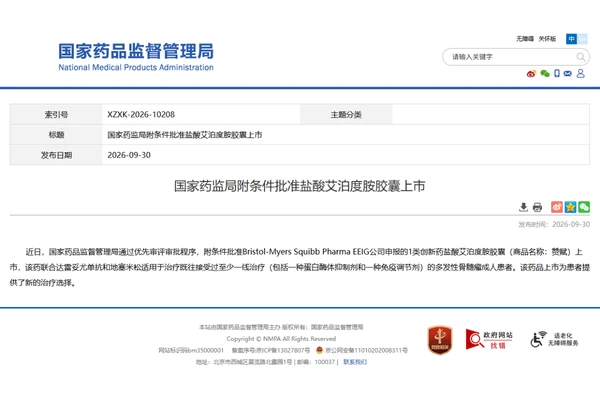
Drug name: Iberdomide hydrochloride
Approval date: September 30, 2026
Approving authority: National Medical Products Administration (NMPA)
Indication: In combination with daratumumab and dexamethasone, for adult patients with multiple myeloma who have received at least one prior line of therapy, including a proteasome inhibitor and an immunomodulatory agent [1].
Iberdomide belongs to the CELMoD (Cereblon E3 Ligase Modulator) class, representing the further development of immunomodulatory treatment for multiple myeloma toward protein degradation mechanisms.
From an industry perspective, its value lies not only in adding a new product, but also in the following aspects:
- A new mechanism enters the Chinese market;
- It forms a combination therapy with existing antibody drugs;
- It further strengthens precision stratification and combination treatment for multiple myeloma;
- It provides a new commercialization case for the subsequent development of protein-degrading drugs.
This indicates that the focus of competition among innovative oncology drugs is shifting from “single-agent efficacy” toward a combination of mechanisms, lines of therapy, and patient stratification.
III. Two RSV Monoclonal Antibodies Approved: Pediatric Prevention Becomes a New Market Segment
Among the new drug approvals in September, the two RSV preventive monoclonal antibodies are particularly noteworthy.
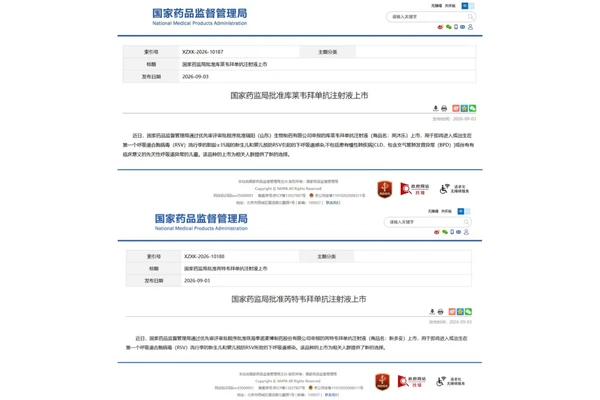
Drug names: Clulevibart and Retavibart
Approval date: September 3, 2026
Approving authority: National Medical Products Administration (NMPA)
Indications:
- Clulevibart is indicated for the prevention of lower respiratory tract infection caused by RSV in newborns and infants with a gestational age of ≥35 weeks who are about to enter or are born during their first respiratory syncytial virus season. Children with chronic lung disease (CLD, including bronchopulmonary dysplasia [BPD]) or clinically significant congenital airway abnormalities are excluded.
- Retavibart is indicated for the prevention of lower respiratory tract infection caused by respiratory syncytial virus (RSV) in newborns and infants who are about to enter or are born during their first RSV season.
Retavibart is a domestically developed, long-acting, fully human anti-RSV monoclonal antibody in China [2]. It targets a conserved epitope on the prefusion conformation (Pre-F) protein of RSV and prevents the virus from entering host cells by neutralizing it.
The simultaneous approval of these two products has considerable industry significance. In the past, the RSV prevention market was mainly served by imported products. With the entry of domestically developed long-acting monoclonal antibodies into the market, competition in the industry will increasingly focus on:
- Duration of protection;
- Population coverage;
- Product pricing;
- Maternal, infant, and pediatric distribution channels;
- Seasonal inventory management;
- Awareness among patients and parents.
Therefore, RSV prevention may gradually move from simple “product competition” into comprehensive competition involving products, channels, payment, and market education.
IV. Etripamil: Drug Administration Becomes an Important Direction for Innovation
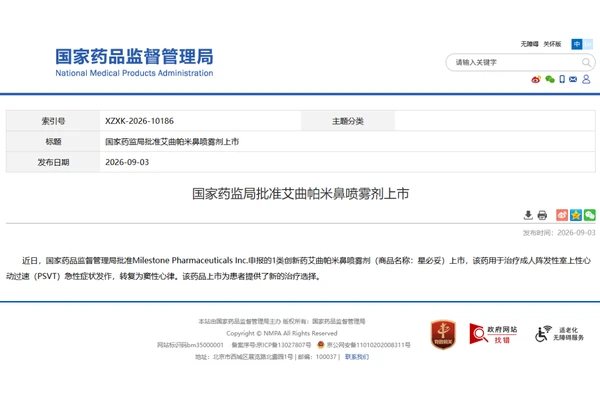
Drug name: Etripamil
Approval date: September 3, 2026
Approving authority: National Medical Products Administration (NMPA)
Indication: For the conversion of acute episodes of paroxysmal supraventricular tachycardia (PSVT) to sinus rhythm in adults [3].
Compared with traditional treatment methods, the most prominent feature of Etripamil is its nasal spray administration. The industry trend reflected by this product is clear: innovative drugs do not necessarily need to involve “new targets”; innovative drug delivery methods can also redefine treatment settings.
For acute conditions such as PSVT, convenient drug administration has considerable clinical value. If some patients can, in the future, receive timely treatment outside medical institutions, its commercial value will come not only from the drug itself but also from changes to traditional treatment pathways.
V. Rilzabrutinib: BTK Expands from Oncology into Immune Diseases
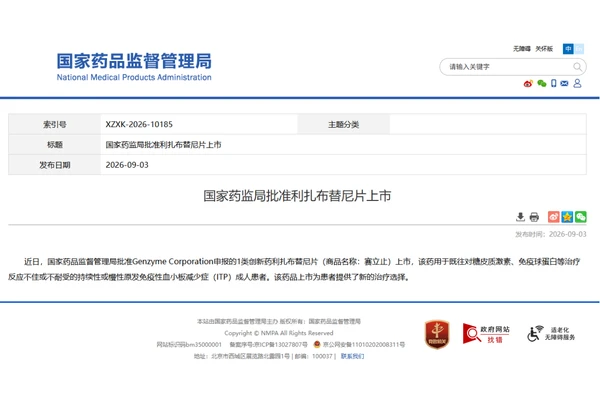
Drug name: Rilzabrutinib
Approval date: September 3, 2026
Approving authority: National Medical Products Administration (NMPA)
Indication: For adult patients with persistent or chronic primary immune thrombocytopenia (ITP) who have had an inadequate response to or are intolerant of previous treatments such as glucocorticoids and immunoglobulins. Rilzabrutinib is a reversible covalent BTK inhibitor [4].
BTK has primarily been used in hematologic oncology. Its entry into ITP treatment further demonstrates that established targets are seeking new growth opportunities through indication expansion.
This also means that the value of an established target can no longer be assessed solely on the basis of its first indication. Instead, it needs to be evaluated across its entire lifecycle: target value → development for multiple indications → combination therapy → lifecycle management.
VI. Three Changes in the 2026 Innovative Drug Market Reflected by the Five New Drugs
1. Innovation Is Moving from “Targets” to “Comprehensive Innovation”
Iberdomide hydrochloride represents a new mechanism, Rilzabrutinib represents the expansion of an established target into the field of immunology, and Etripamil represents innovation in drug administration. In the future, competition among innovative drugs will increasingly emphasize the combined value of mechanisms, dosage forms, patient experience, and treatment settings.
2. The Preventive Biologics Market Is Expanding
The simultaneous approval of two long-acting RSV monoclonal antibodies means that domestically developed innovative biologics in China have officially entered the RSV prevention market. Compared with therapeutic drugs, these products depend more heavily on population structure, epidemic seasons, pediatric channels, and affordability. As a result, their commercialization models are also more complex.
3. Approval Is Only the Starting Point for Commercialization
For pharmaceutical companies, pharmaceutical distributors, and pharmacy professionals, attention to new drug approvals in September should not be limited to “which products have been approved.”
More importantly, it is necessary to assess the size of the indication, where the patients are, what the clinical pathway looks like, how hospital access will be achieved, how payment will be addressed, how distribution channels will be covered, and whether there is room for subsequent indication expansion. These factors ultimately determine whether an innovative drug can move from an “approved product” to a “commercialized product.”
Conclusion
NMPA drug approvals in September 2026 demonstrated clear diversification. Iberdomide hydrochloride introduces a new CELMoD mechanism; Retavibart and Clulevibart help bring domestically developed RSV preventive monoclonal antibodies in China into the market; Etripamil explores new treatment settings through nasal spray administration; and Rilzabrutinib advances the expansion of the BTK target into the field of autoimmune diseases.
Therefore, the core signal released by these new drug approvals in September is not simply an “increase in the number of approvals.” Rather, China’s innovative drug market is entering a new stage that places greater emphasis on mechanistic innovation, drug delivery innovation, the preventive medicine market, and lifecycle management.
References
[1] Lonial S, Dimopoulos MA, Berdeja JG, Richardson PG, Quach H, Rodríguez-Otero P, Maciag P, Hong K, Amatangelo M, Chen M, van de Donk NWCJ. EXCALIBER-RRMM: a phase III trial of iberdomide, daratumumab, and dexamethasone in relapsed/refractory multiple myeloma. Future Oncol. 2025 Jun;21(14):1761-1769.
[2]Li Y ,Tian D ,Pan L , et al. 560. Efficacy and Safety of Retavibart, a Long-acting Monoclonal Antibody, for the Prevention of Respiratory Syncytial Virus-Induced Lower Respiratory Tract Infection: A Phase 2b Trial in Infants Entering Their First Epidemic Season[J].Open Forum Infectious Diseases,2026,13(Supplement_1)
[3]Ip JE, Coutu B, Ip JH, Noseworthy PA, Parody ML, Rafii F, Sears SF, Singh N, Stambler BS, Tahirkheli NK, Agudelo-Uribe J, Hu D, Shardonofsky S, Sheikh MB, Holz A, Bharucha DB, Camm AJ. Etripamil Nasal Spray for Recurrent Paroxysmal Supraventricular Tachycardia Conversion: Results From the NODE-303 Open-Label Study. J Cardiovasc Electrophysiol. 2025 Nov;36(11):2990-3003.
[4]Kuter, D. J., & Ghanima, W. (2025). Evaluating rilzabrutinib in the treatment of immune thrombocytopenia. Immunotherapy, 17(11), 767–782.