
In recent years, antibody-drug conjugates (ADCs) have become a major focus of global oncology drug development, combining precise targeting with potent cytotoxic activity. With continued advances in antibody engineering, linker chemistry, drug conjugation, and novel payloads, ADC development has expanded beyond traditional hematologic malignancies to a range of solid tumors, including breast, gastric, lung, and urothelial cancers, reshaping the global landscape of cancer treatment.
According to Grand View Research, China’s ADC market was valued at approximately US$747.6 million in 2024 and is projected to reach US$2.2973 billion by 2033, representing a compound annual growth rate (CAGR) of approximately 12.4% over the forecast period [1]. Data Bridge Market Research projects that the market could grow at a CAGR of 19.21% between 2024 and 2032 [2].
As ADC development progresses from technological accumulation toward clinical value validation, competition in China’s ADC market is shifting away from pipeline size and target selection alone toward clinical differentiation, platform capabilities, commercialization efficiency, and the ability to realize value in global markets.
I. Continuous Technological Innovation Is Driving the Evolution of China’s ADC market
ADCs generally consist of three core components:
- Antibody: Recognizes tumor-associated antigens and determines the drug’s targeting capability.
- Linker: Connects the antibody to the payload. Its stability and release mechanism influence the drug’s behavior in the body.
- Payload: Produces the cytotoxic effect and directly contributes to the drug’s antitumor activity.
Together, these components determine an ADC’s targeting capability, payload-release characteristics, pharmacokinetic profile, and safety.
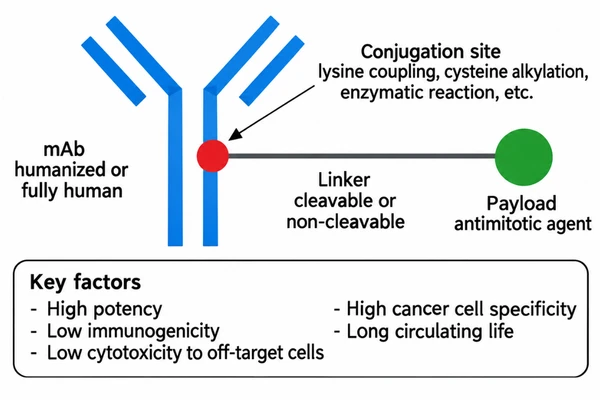
After administration, the antibody component binds to the target antigen on the surface of tumor cells. The ADC is then internalized by the cells, where the active payload is released in the intracellular environment and exerts its cytotoxic effect. Some ADCs also exhibit a bystander effect, whereby the released payload can enter neighboring tumor cells, potentially enhancing tumor-cell killing in tumors with heterogeneous antigen expression.
ADCs are more than simple combinations of antibodies and chemotherapy drugs. Target selection and antibody affinity, linker stability in systemic circulation, payload potency and membrane permeability, and the drug-to-antibody ratio (DAR) can all influence therapeutic performance.
From a technological perspective, ADC development has evolved from relatively simple conjugation approaches toward designs that place greater emphasis on linker stability, controlled payload release, and product homogeneity. Site-specific conjugation technologies enable more precise control over the locations and numbers of payloads attached to antibodies, potentially improving product homogeneity and certain pharmacokinetic characteristics. Meanwhile, newer payloads, including topoisomerase I inhibitors, continue to expand the therapeutic potential of ADCs.
In addition to conventional monoclonal antibody-based ADCs, bispecific ADCs, novel payloads, and combinations of ADCs with immune checkpoint inhibitors have become important research and development directions in China’s ADC market [3].
II. A Diversifying Competitive Landscape Is Helping Chinese Pharmaceutical Companies Build Advantages
China’s ADC industry has developed into a competitive ecosystem involving large pharmaceutical companies, innovative biotechnology firms, and specialized R&D platforms. Companies have different strengths in target selection, linker design, payload development, and clinical resources, gradually shifting China’s ADC market from technology catch-up toward differentiated innovation [4].
Rongchang Biopharmaceutical: A Representative Domestic ADC
Rongchang Biopharmaceutical is an important participant in China’s ADC sector. Its independently developed Disitamab Vedotin (RC48), which targets HER2, is a representative product in the development of China’s domestic ADC industry. The drug has received marketing approval in China and has also progressed through international development activities, illustrating a potential pathway for domestically developed ADCs from clinical research to commercialization and globalization.
Hengrui Pharmaceuticals: Expanding Its Pipeline Across Multiple Targets
Hengrui Pharmaceuticals continues to develop ADC programs targeting HER2, TROP2, Claudin 18.2, and other targets. The company is also building capabilities in antibody engineering, linker chemistry, and drug conjugation.
Its ADC candidates cover multiple solid-tumor indications, reflecting how an established pharmaceutical company can compete in China’s ADC market through a diversified product pipeline.
Hansoh Pharma and Specialized Biotechnology Companies
Hansoh Pharma is also continuing to develop its ADC technology platform, with pipeline candidates targeting different antigens. By optimizing combinations of antibodies, linkers, and payloads, the company aims to establish advantages in efficacy, safety, and product differentiation.
In addition, biotechnology companies specializing in ADC development are contributing to industry innovation through modular design, linker-payload platforms, high-throughput screening, and other technological approaches.
Established Targets and Emerging Targets Are Developing in Parallel
HER2 and TROP2 have attracted substantial R&D investment because of their clinical validation and sizable potential patient populations. Meanwhile, targets such as B7-H3, FRα, Nectin-4, and Claudin 18.2 are also receiving increasing attention.
Although well-established targets can provide a clearer foundation for drug development, excessive concentration on a limited number of targets may intensify competition, create challenges in clinical trial recruitment, and increase future commercialization pressures.
III. Licensing and Partnerships Are Accelerating the Globalization of China’s ADC Market
As Chinese pharmaceutical companies strengthen their ADC R&D capabilities, international partnerships are becoming an important mechanism for realizing product value. Multinational pharmaceutical companies generally have established global clinical development, regulatory submission, and commercialization networks, while Chinese innovative drug developers offer their own strengths in R&D efficiency, candidate pipelines, and selected technology platforms. Licensing, co-development, and commercialization partnerships can enable both sides to leverage complementary resources.
For China’s ADC market, out-licensing agreements can generate potential revenue through upfront payments, development and regulatory milestone payments, and sales royalties. They can also help Chinese companies accelerate overseas development by drawing on their partners’ international R&D experience.
However, the headline value of a licensing deal does not equate to actual revenue. Milestone payments are generally contingent on conditions such as clinical progress, regulatory approvals, or commercial performance. The total potential transaction value alone is therefore insufficient to determine a product’s commercial value.
International partnerships can also encourage Chinese ADC developers to plan global clinical development strategies earlier. Requirements for clinical trial design, patient enrollment, drug registration, and market access differ across countries and regions. Companies need to develop appropriate strategies based on disease burden, existing treatment options, and competing products in each target market.
Global competition also places higher demands on Chinese ADC developers. As structurally complex medicines, ADCs require careful consideration of antibody and payload quality control, the reproducibility of linker chemistry and conjugation processes, nonclinical safety, pharmacokinetics, and clinical trial design. Companies must also coordinate development and regulatory requirements across different jurisdictions.
IV. Policy Support and Reimbursement Access Influence the Development of China’s ADC market
Regulatory policies and reimbursement environments are important factors affecting ADC commercialization. ADCs combine biologic antibodies with small-molecule cytotoxic payloads, making their development dependent on complex pharmaceutical research, process development, and quality evaluation. As relevant technical guidelines continue to evolve, companies may gain clearer guidance for product design, process control, and quality studies.
In China, regulatory mechanisms such as priority review and approval for innovative drugs, the Marketing Authorization Holder (MAH) system, and reimbursement negotiations for innovative medicines provide an important institutional foundation for ADC development and commercialization.
The MAH system allows eligible drug developers to integrate industry resources through arrangements such as contract manufacturing. However, ADC manufacturing involves highly potent payloads and complex conjugation processes, requiring appropriate facilities, quality management systems, and safety controls.
Reimbursement access directly affects patient access and product uptake. ADCs generally involve substantial R&D and manufacturing costs, while post-approval pricing and reimbursement levels can influence patients’ ability to access treatment, procurement by healthcare institutions, and companies’ commercial performance.
Inclusion in reimbursement programs may reduce patients’ financial burden, but companies must also balance price adjustments, market size, and sustainable profitability.
Ultimately, growth in China’s ADC market will depend not only on the number of newly approved drugs, but also on whether these therapies address genuine clinical needs, obtain appropriate reimbursement support, and can be used appropriately within healthcare institutions.
V. Key Challenges Facing China’s ADC Market
Despite its promising outlook, China’s ADC market continues to face several challenges.
1. Intensifying Competition for Established Targets
Targets such as HER2 and TROP2 have attracted substantial investment, but targeting the same antigen does not necessarily translate into comparable clinical value.
When multiple candidates lack meaningful differences in their target patient populations, mechanisms of action, or efficacy profiles, companies may face higher clinical development costs and greater commercialization pressure. Differentiated target selection and clear clinical positioning will therefore remain important competitive strategies for Chinese ADC developers.
2. Strengthening First-in-Class Innovation
Chinese companies have accumulated experience in applying and optimizing certain established ADC technologies. However, the discovery of novel targets, development of new payloads, and creation of innovative conjugation technologies require continued investment in basic research and translational medicine.
Building sustainable technological innovation capabilities will help companies reduce their reliance on popular targets and established development approaches.
3. Improving Key Raw Material Supply and Manufacturing Capabilities
Highly potent payloads, specialized linker materials, dedicated manufacturing equipment, and advanced analytical technologies are all important components of ADC development and manufacturing.
Improving the stability of key raw material supplies and strengthening process scale-up and quality control can help reduce supply chain risks. For companies operating in China’s ADC market, manufacturing reliability and consistent product quality are also essential foundations for global development.
4. Balancing Clinical Development and Commercialization Pressures
The efficacy and safety of ADCs depend on multiple factors, including target expression, patient selection, molecular design, and dosing regimens. Companies need well-designed clinical trials to define appropriate patient populations and treatment positioning, rather than relying solely on early-stage data to assess a candidate’s potential.
R&D investment, clinical development timelines, market access, and sales and marketing activities all affect a product’s eventual commercial returns.
To address these challenges, Chinese pharmaceutical companies are shifting their focus from simply expanding pipelines toward improving project quality. Priorities include strengthening target validation and differentiation, optimizing antibody-linker-payload combinations, improving the integration of preclinical and clinical data, and considering international regulatory and commercialization strategies earlier in development.
VI. Outlook: China’s ADC Market Is Entering an Era of Quality and Value-Based Competition
Overall, ADCs are undergoing simultaneous advances in technology, clinical development, and commercialization. The continued launch of domestically developed ADC products, expansion of innovative pipelines, and deepening of international partnerships are providing multiple sources of growth for China’s ADC market [5].
From a technological perspective, site-specific conjugation, novel payloads, bispecific ADCs, and combination treatment strategies may further expand the range of potential applications. From an industry perspective, Chinese companies are strengthening their technology platforms and global development strategies. From a market perspective, clinical needs, reimbursement access, and commercialization capabilities will collectively determine the real-world performance of ADC products.
Looking ahead, China’s ADC market is poised to play an increasingly important role in global oncology innovation. For pharmaceutical companies, sustainable competitive advantages will depend on integrating technological innovation, demonstrated clinical value, and global development capabilities. This will help translate China’s ADC research and development achievements into treatment options that are accessible to patients.
References
[1]https://www.grandviewresearch.com/horizon/outlook/antibody-drug-conjugates-market/china
[2]https://www.databridgemarketresearch.com/nucleus/china-antibody-drug-conjugates-market
[3]https://www.ccfdie.org/en/gzdt/webinfo/2024/12/1732613151853611.htm
[4]https://www.nature.com/articles/d41573-025-00185-w
[5]https://www.delveinsight.com/report-store/antibody-drug-conjugate-adc-market